Probability
What Is Probability? Definition, Rules and Worked Examples
Math Solver Free Team
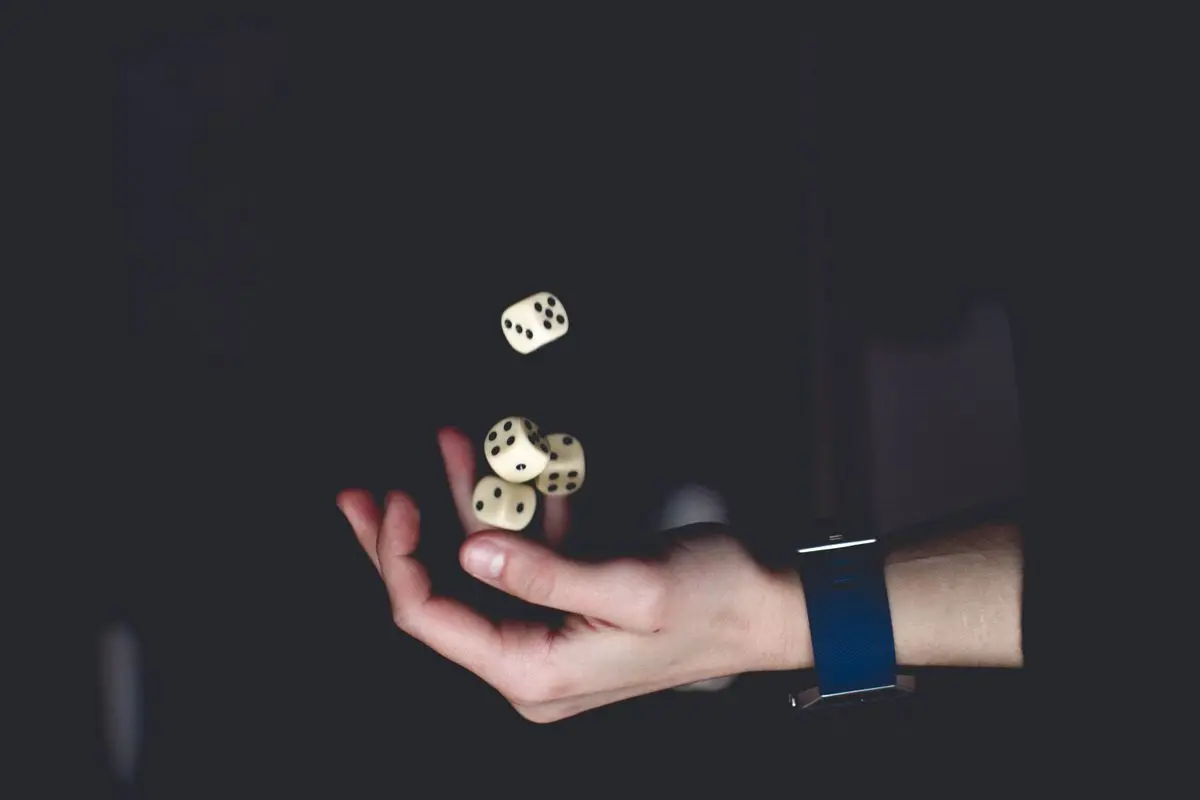
Probability is the mathematics of uncertainty: a number that says how likely something is to happen. Every probability lives on one scale — 0 means impossible, 1 means certain — and almost every school question is answered with one formula plus two rules. This guide builds the idea from the definition up: classical probability with coins, dice, and cards, the difference between independent and dependent events, the multiply rule for AND, the add rule for OR, and how to move between fractions and percents. Check any example afterwards in the probability calculator.
The definition: a scale from 0 to 1
For an event E, probability is written P(E). When all outcomes are equally likely, the classical probability formula is:
P(E) = number of favourable outcomes ÷ total number of possible outcomes
The result is always a fraction between 0 and 1. Rolling a 7 on an ordinary six-sided die has probability 0 — it cannot happen. Rolling a number from 1 to 6 has probability 1 — it cannot fail to happen. Everything real sits between: a probability of 0.5 means "as likely as not", 0.9 means "very likely but not guaranteed", and 0.1 means "unlikely but entirely possible". Multiply by 100 to state the same chance as a percent: 0.5 = 50%, 0.25 = 25%.
Coins, dice, and cards: the classical examples
- One coin flip: P(heads) = 1 favourable outcome ÷ 2 possible = 1/2 = 0.5 = 50%.
- One die roll — a six: P(6) = 1 ÷ 6 = 1/6 ≈ 16.7%.
- One die roll — an even number: the favourable outcomes are 2, 4, 6, so P(even) = 3 ÷ 6 = 1/2.
- One die roll — more than 4: favourable outcomes 5 and 6, so P = 2 ÷ 6 = 1/3.
- One card from a 52-card deck — an ace: there are 4 aces, so P(ace) = 4 ÷ 52 = 1/13 ≈ 7.7%.
- One card — a red card: 26 of the 52 cards are red, so P(red) = 26 ÷ 52 = 1/2.
Every one of these is the same move: count what you want, count everything that could happen, divide, and simplify the fraction.
Independent vs dependent events
Two events are independent when the outcome of one does not change the probabilities of the other. Flipping a coin twice: the coin has no memory, so the second flip is still 1/2 heads whatever the first showed. Drawing a card and replacing it before drawing again is also independent — the deck is restored.
Events are dependent when the first outcome changes what remains. Draw a card and keep it: the deck now has 51 cards, so every probability for the second draw shifts. "Without replacement" in a question is the signal that the events are dependent and the denominators will shrink.
The AND rule: multiply
For the probability that two independent events both happen, multiply their probabilities: P(A and B) = P(A) × P(B).
- Two heads in two flips: 1/2 × 1/2 = 1/4 = 25%. (The four equally likely results are HH, HT, TH, TT — only one is HH.)
- Two sixes with two dice: 1/6 × 1/6 = 1/36 ≈ 2.8%.
- A total of 7 with two dice: this is not one AND — six different pairs make 7: (1,6), (2,5), (3,4), (4,3), (5,2), (6,1). Each pair has probability 1/36, so P(total 7) = 6 ÷ 36 = 1/6 — which is why 7 is the most likely two-dice total.
The OR rule: add — and subtract the overlap
For the probability that one event or another happens, add their probabilities: P(A or B) = P(A) + P(B) — provided they cannot happen together. Rolling a 2 or a 5 with one die: 1/6 + 1/6 = 2/6 = 1/3. A single roll cannot be both 2 and 5, so nothing is double-counted.
When the events can happen together, the overlap has been counted twice and must be subtracted once: P(A or B) = P(A) + P(B) − P(A and B).
Worked example — red or king: P(red) = 26/52, P(king) = 4/52, but the 2 red kings sit in both counts, so P(red and king) = 2/52. Then P(red or king) = 26/52 + 4/52 − 2/52 = 28/52 = 7/13 ≈ 53.8%. Forgetting the overlap is the classic OR-rule error; the count 30/52 is the classic wrong answer.
Dependent events: adjust, then multiply
The AND rule still multiplies for dependent events — you just update the second probability for what the first draw removed.
Worked example — two aces without replacement: P(first ace) = 4/52. One ace is gone, leaving 51 cards of which 3 are aces: P(second ace) = 3/51. Multiply: 4/52 × 3/51 = 12/2652 = 1/221 ≈ 0.45%. With replacement it would be 4/52 × 4/52 = 1/169 — replacement always helps when you want the same card again.
Worked example — marbles: a bag holds 5 red and 3 blue marbles. Two reds drawn without replacement: 5/8 × 4/7 = 20/56 = 5/14 ≈ 35.7%.
Probability as a percent, and the complement
To convert, multiply the fraction by 100: 1/4 = 25%, 3/8 = 0.375 = 37.5%, 1/6 ≈ 16.7%, 7/13 ≈ 53.8%. The complement is the probability the event does not happen: P(not E) = 1 − P(E). The probability of not rolling a six is 1 − 1/6 = 5/6 ≈ 83.3%. Complements unlock a famous shortcut: "at least one head in three flips" is painful to count directly, but 1 − P(no heads) = 1 − (1/2)³ = 1 − 1/8 = 7/8 = 87.5%.
Common mistakes
- The gambler's fallacy. After five heads in a row, tails is not "due" — the coin is memoryless and the next flip is still 1/2. Past independent outcomes change nothing.
- Adding when you should multiply. "Both happen" means AND, and AND multiplies. Adding 1/2 + 1/2 for two heads gives 1 — certainty — which the four outcomes HH, HT, TH, TT immediately disprove.
- Forgetting the overlap in OR. If both events can happen at once, subtract the overlap once, as in red-or-king.
- Assuming equally likely outcomes when they are not. The classical formula needs equally likely outcomes. "It will rain or it won't, so 50%" is wrong — those two outcomes are not equally likely; weather probabilities come from models and past frequencies, not counting.
- Probabilities above 1 or below 0. Any result outside 0 to 1 (or 0% to 100%) is automatically an error — a built-in alarm bell worth using.
How the probability calculator helps
The probability calculator handles single events, AND/OR combinations, and repeated independent trials, showing the answer as a fraction, a decimal, and a percent together. Work your problem by hand first — decide AND or OR, independent or dependent — then let the calculator confirm the arithmetic. Most student errors are rule choices, not arithmetic, and seeing the calculator's setup line next to yours shows immediately which rule you mis-picked.

Frequently asked questions
What is probability in simple words?
Probability is a number between 0 and 1 that measures how likely an event is: 0 means it cannot happen, 1 means it certainly will, and 0.5 means it is as likely to happen as not.
How do you calculate the probability of an event?
When outcomes are equally likely, divide the number of favourable outcomes by the total number of possible outcomes. Drawing an ace: 4 aces out of 52 cards, so 4/52 = 1/13.
What is the difference between independent and dependent events?
Independent events do not affect each other — coin flips, or draws with replacement. Dependent events change the remaining probabilities — drawing cards or marbles without replacement shrinks the totals for the next draw.
When do you add probabilities and when do you multiply?
Add for OR (this or that happens), multiply for AND (both happen). If two OR events can happen together, subtract the overlap once so it is not counted twice.
What is the probability of getting two heads in two coin flips?
1/2 × 1/2 = 1/4, or 25%. Of the four equally likely results — HH, HT, TH, TT — exactly one is two heads.
Can a probability be more than 1 or written as a percent?
Never more than 1 as a fraction or decimal — that would mean more likely than certain. Multiply by 100 to write it as a percent instead: 0.75 and 75% are the same probability.